
What Is RaadsRTests.com?
RaadsRTests.com is the official online resource for the RAADS-R test for autism. The site provides a comprehensive, scientifically grounded version of the RAADS-R screening tool that anyone can access from the comfort of their home — entirely free of charge. Beyond the RAADS-R, the platform also offers other free neurocognitive assessments, including a free Neurodivergence Test designed to explore a broader range of neurodivergent traits, and a free AuDHD Test that screens for the co-occurrence of autism and ADHD. Whether you are beginning your journey toward self-understanding or seeking a preliminary screening before consulting a professional, RaadsRTests.com is a trusted starting point for thousands of individuals worldwide.

What Is the RAADS-R Test?
The RAADS-R, which stands for the Ritvo Autism Asperger Diagnostic Scale–Revised, is a self-report questionnaire developed by Dr. Riva Ariella Ritvo and colleagues at the Yale Child Study Center. It was specifically designed to assist clinicians in identifying autism spectrum disorder (ASD) in adults — particularly those who may have gone undiagnosed throughout childhood and adolescence. Unlike many autism screening tools that were originally created for children, the RAADS-R addresses the unique presentations of autism in adult populations, recognizing that many individuals develop sophisticated masking and coping strategies over the years that can obscure core autistic traits.
The test was first published in the Journal of Autism and Developmental Disorders in 2011 and has since become one of the most widely cited and utilized adult autism screening instruments in clinical research. It is important to understand that the RAADS-R is a screening tool and not a diagnostic instrument in isolation. A formal autism diagnosis should always involve a comprehensive evaluation by a qualified healthcare professional. However, the RAADS-R serves as an invaluable first step in identifying whether further evaluation may be warranted.
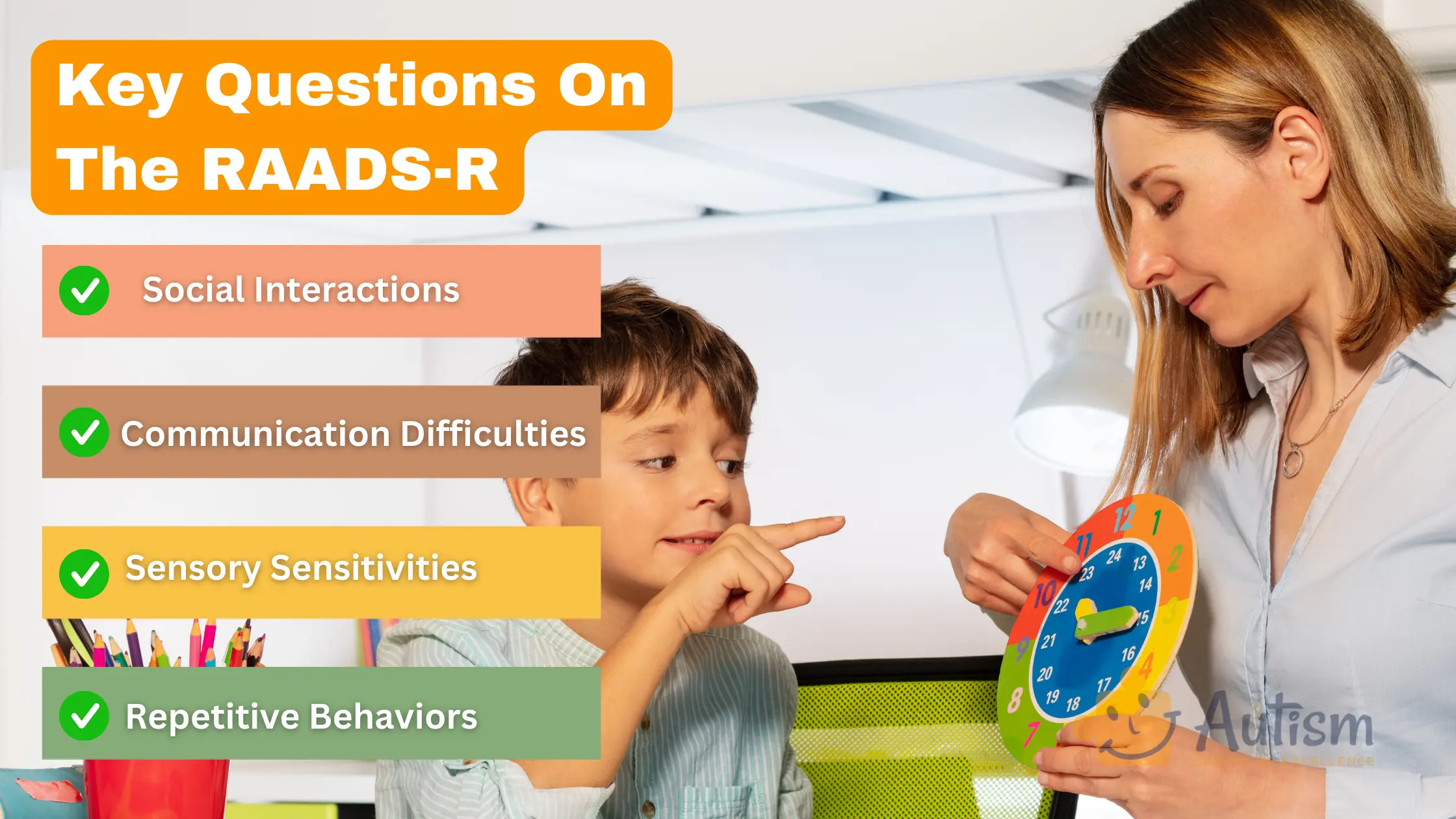
What Does the RAADS-R Measure?
The RAADS-R consists of 80 statements that respondents rate based on how well each statement describes their experiences, both currently and during their earlier life. The test measures autistic traits across four key domains, each capturing a distinct dimension of the autism spectrum:
- Language: This subscale examines pragmatic language difficulties, including challenges with understanding figurative speech, sarcasm, idioms, and the nuances of conversational turn-taking. It also looks at tendencies toward literal interpretation and difficulty reading between the lines in social communication.
- Social Relatedness: This is the largest subscale and assesses the quality and nature of social interactions. It explores difficulties with forming and maintaining friendships, understanding social hierarchies, interpreting others' emotions and intentions, and navigating the unwritten rules that govern social behavior.
- Sensory-Motor: This subscale measures sensory processing differences and motor coordination challenges. It includes hypersensitivity or hyposensitivity to sounds, textures, lights, tastes, and smells, as well as unusual motor behaviors such as stimming, clumsiness, or difficulty with fine motor tasks.
- Circumscribed Interests: This domain captures the intensity and focus of special interests, a hallmark trait of autism. It assesses whether an individual tends to become deeply absorbed in specific topics, often to the exclusion of other activities, and whether these interests are unusually intense compared to neurotypical peers.
Each statement is scored on a four-point scale that accounts for whether a trait has been present throughout life or has emerged or diminished over time. The total score ranges from 0 to 240, with a threshold score of 65 or above suggesting that the individual may be on the autism spectrum. Research has demonstrated that the RAADS-R has a sensitivity of 97% and a specificity of 100% in clinical settings, making it one of the most accurate self-report screening tools available for adult autism. You can complete the full assessment for free at RaadsRTests.com.
Why Is the RAADS-R Important for Adults?
For decades, autism was primarily understood as a childhood condition, and diagnostic criteria were built around how autism presents in young boys. This narrow view left countless individuals — particularly women, non-binary people, and those with high-masking presentations — without answers well into adulthood. Many adults who are eventually diagnosed with autism describe a lifetime of feeling "different" without understanding why, often receiving misdiagnoses of anxiety, depression, bipolar disorder, or personality disorders along the way.
The RAADS-R was created to address this gap. By asking questions that reflect the lived experiences of autistic adults rather than the behavioral observations typically used in childhood assessments, it captures the subtler and often internalized manifestations of autism. The inclusion of retrospective questions — asking respondents to reflect on their experiences across their lifespan — is particularly valuable, as it helps distinguish between traits that are intrinsic to autism and those that may be situational or related to other conditions.
"Understanding that you are autistic as an adult can be profoundly life-changing. It reframes a lifetime of experiences through a lens of neurodivergence rather than personal failure, opening the door to self-acceptance, appropriate support, and community."
Other Tests for Autism Spectrum Disorder
While the RAADS-R is one of the most robust self-report tools for adult autism screening, it is far from the only assessment available. Understanding the landscape of autism testing can help individuals choose the right combination of tools for their needs. Here are some of the other prominent tests and assessments used in autism evaluation:
1. The Autism Spectrum Quotient (AQ)
Developed by Simon Baron-Cohen and his team at the Autism Research Centre at the University of Cambridge, the AQ is a 50-item questionnaire that measures the degree of autistic traits in adults with normal intelligence. It is widely used as a quick screening tool and has been translated into dozens of languages. While it is not diagnostic on its own, a score of 32 or above is generally considered to indicate clinically significant levels of autistic traits.
2. The Autism Diagnostic Observation Schedule (ADOS-2)
Often considered the "gold standard" of autism diagnosis, the ADOS-2 is a semi-structured, standardized assessment that is administered by trained clinicians. It involves a series of activities and conversations designed to elicit behaviors associated with autism. Unlike self-report questionnaires, the ADOS-2 relies on direct observation and requires specialized training to administer and score.
3. The Autism Diagnostic Interview–Revised (ADI-R)
The ADI-R is a comprehensive interview conducted with a parent or caregiver and is typically used alongside the ADOS-2 for diagnostic purposes. It covers the individual's developmental history, language and communication abilities, social interactions, and restricted and repetitive behaviors. While extremely thorough, it is time-intensive and primarily designed for use in clinical and research settings.
4. The Camouflaging Autistic Traits Questionnaire (CAT-Q)
The CAT-Q is a newer tool that specifically measures the extent to which an individual camouflages or masks their autistic traits in social situations. This is particularly relevant for late-diagnosed adults, especially women and gender-diverse individuals, who often develop extensive masking strategies that can obscure their autism from both themselves and others.
5. Neurodivergence and AuDHD Screening
Beyond autism-specific tests, broader neurodivergence screenings can help identify overlapping conditions. Many autistic individuals also have ADHD — a combination sometimes referred to as AuDHD. RaadsRTests.com offers a AuDHD Test to screen for this co-occurrence, as well as a comprehensive Neurodivergent Test that explores traits across multiple neurocognitive dimensions.
The RAADS-R Test on RaadsRTests.com Is Completely Free
One of the most significant barriers to autism screening and diagnosis is cost. Professional diagnostic evaluations can range from several hundred to several thousand dollars, and waitlists in many countries stretch to months or even years. This financial and logistical burden disproportionately affects marginalized communities, low-income individuals, and those without access to specialized healthcare providers.
That is precisely why the availability of a completely free RAADS-R test on RaadsRTests.com is so valuable. The platform removes financial barriers entirely, allowing anyone with an internet connection to access a validated, scientifically backed autism screening tool at no cost. The test is presented in a user-friendly format, provides immediate results, and includes helpful context for interpreting scores. While it does not replace a professional diagnosis, it empowers individuals to take the first step toward understanding their neurological profile and advocating for themselves in clinical settings.
The free RAADS-R test on RaadsRTests.com has helped thousands of people recognize autistic traits they may have carried unnoticed for decades. For many, it represents the beginning of a transformative journey — one that leads to greater self-understanding, targeted support, meaningful community connections, and ultimately, a deeper sense of belonging in a world that was not always designed for neurodivergent minds.
How to Prepare for Taking the RAADS-R
Taking the RAADS-R is straightforward, but a few tips can help ensure that your results are as accurate and meaningful as possible. First, find a quiet, comfortable environment where you will not be interrupted or rushed. The test takes approximately 15 to 30 minutes to complete. Second, answer each question honestly based on your genuine experiences rather than how you think you "should" respond. Many autistic adults have spent years learning to mask their traits, so it can be helpful to think about how you feel internally rather than how you appear externally. Third, remember that this is a screening tool, not a final verdict. Whatever your score, it provides useful information that you can bring to a healthcare professional for further discussion.
Ready to Learn More About Yourself?
Take the free, scientifically validated RAADS-R test today and gain valuable insight into your neurocognitive profile.
🚀 Start the Free RAADS-R Test